This information is not a substitute for professional medical advice, diagnosis, or treatment. Always ask your doctor or other qualified healthcare provider, especially for help with sizing and fit. In an emergency, call 911.
Choosing a wheelchair is one of the biggest decisions in anyone's mobility journey, and the right choice depends entirely on the person: how far and how often they'll be moving, whether they can propel themselves, where the chair will be used, and how it needs to travel with them. This guide walks through the basics so you can narrow the field before you buy — and know which questions to bring to a doctor or therapist.
A quick word on fit first. A wheelchair that's the wrong size can be uncomfortable, unsafe, or hard to maneuver. Seat width, seat depth, and back height all need to match the user's body, and that's something a doctor, physical therapist, or occupational therapist can measure properly. This guide covers what to look for in general; it isn't a substitute for that kind of personalized fitting.
Manual vs. Powered: The First Fork in the Road
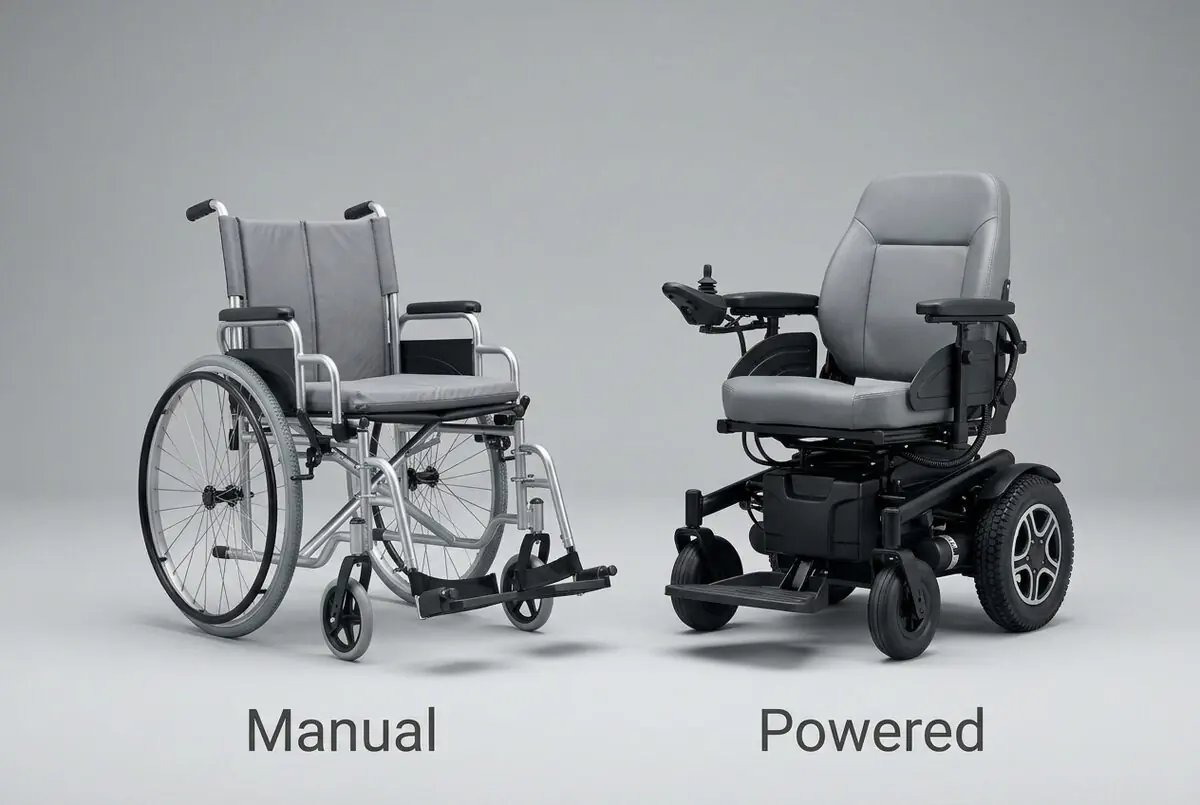
Manual wheelchairs are propelled by the user (pushing the wheels by hand) or by someone else pushing from behind. They're lighter, simpler, have no battery to charge, and are generally easier to transport in a car or store in a closet. They make sense for someone with enough upper-body strength and stamina to self-propel, or for situations where a caregiver will always be pushing.
Powered (electric) wheelchairs use a battery and a joystick or control panel to move the chair, so the user doesn't need upper-body strength to get around. They're the better fit for longer distances, more significant mobility limitations, or all-day independent use. The tradeoff is weight, a battery that needs charging and eventually replacing, and a steeper learning curve for the controls.
The Main Types You'll Run Into
Standard manual wheelchairs — the familiar big-wheeled chair with push-rims the user grips to self-propel, or handles in back for a caregiver to push.
Transport wheelchairs — a lightweight, foldable wheelchair built mainly for someone else to push rather than for the user to self-propel. The wheels are smaller all around, which keeps the chair light and compact, but makes self-propelling impractical.
Lightweight and ultra-lightweight manual chairs — built from aluminum or similar materials to cut overall weight, making them easier to lift into a car trunk or push over longer distances.
Folding electric/power wheelchairs — powered chairs engineered to fold down smaller than a traditional power chair, aimed at people who need powered mobility but also need to travel with it.
Portable or travel power wheelchairs — a lighter, more compact powered option, generally with a shorter battery range than a full-size power chair.
All-terrain wheelchairs — built with wider tires and sturdier frames for use on gravel, grass, or uneven outdoor ground.
What to Check Before You Buy
Weight capacity. Every wheelchair has a maximum user weight; check it against the actual user, not just general build.
Seat width and depth. Too narrow pinches; too wide makes it harder to self-propel and harder to fit through doorways — exactly the kind of measurement a clinician or therapist should confirm.
Where it needs to go. A chair that's perfect at home might not fold small enough for the trunk of a sedan, or might not have the ground clearance for a gravel driveway.
Who's doing the pushing (if it's manual). A chair sized and balanced for self-propulsion feels different from one meant to be pushed by a caregiver.
Battery range and charging (if it's powered). How far the user realistically travels in a day, and whether there's a convenient place to charge it, both matter more than the chair's maximum spec.
Portability. Does it need to fold or disassemble to fit in a vehicle, and can the person managing it actually lift the pieces?
Frequently Asked Questions
What's the difference between a transport wheelchair and a regular manual wheelchair? A transport wheelchair has smaller wheels all around and is built to be pushed by someone else rather than self-propelled. It's lighter and folds more compactly, but isn't designed for a user to wheel themselves around.
Do I need a power wheelchair, or will a manual one work? It depends on the user's strength, stamina, and how far they need to travel independently day to day. If someone can self-propel comfortably over the distances they actually need to cover, a manual chair is lighter and simpler. If independent, longer-distance, or all-day mobility is the goal, a powered chair is usually the better fit — a good question to bring to a doctor or physical therapist.
Are folding electric wheelchairs as reliable as standard power wheelchairs? Folding and portable power wheelchairs trade off some battery range and bulk for portability, so they're generally better suited to shorter trips and travel than all-day, long-range use.
Can I use a wheelchair outdoors on grass or gravel? Not every wheelchair is built for that. Standard indoor-oriented chairs have smaller, narrower wheels that can struggle on uneven or soft ground. All-terrain wheelchairs are built specifically with wider tires and sturdier frames for outdoor use.
How do I know what size wheelchair to get? Seat width, seat depth, and back height all need to match the user's body and the chair's intended use — best confirmed with a doctor, physical therapist, or occupational therapist rather than estimated.
Will a wheelchair fit in my car? Lightweight manual and transport wheelchairs typically fold down small enough for most car trunks; standard and full-size power wheelchairs are heavier and bulkier and may need a larger vehicle or a ramp/lift.
Ready to find the right wheelchair for your needs? Shop our mobility and home category to browse Great Oak Medical's full range of manual and powered wheelchairs, or reach out to our customer care team if you have questions.
AI assistant · answers from our catalog and policies
Talk to our team:
Monday–Friday, 8:00 AM – 6:00 PM Pacific · The assistant is here any time.
Not medical advice.
Our assistant provides product and order information only. It is not a substitute for professional medical advice, diagnosis, or treatment. Always ask your doctor or other qualified healthcare provider about a medical condition or which product is right for you. In an emergency, call 911.